

Market Update
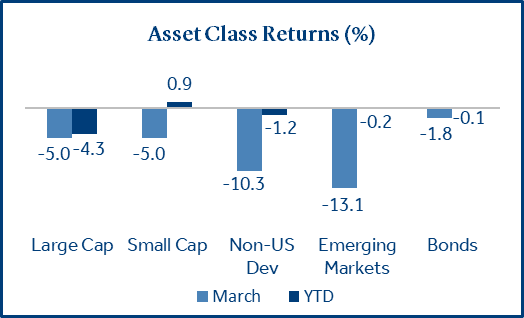
International equities led asset class declines as geopolitical risks intensified, and oil prices surged.
Rising global tensions, higher oil prices, and a jump in interest rates weighed on investor sentiment in March. Stocks and bonds fell as inflation concerns resurfaced and expectations for Fed rate cuts declined, contributing to heightened volatility.
Rising energy costs and the potential for higher inflation weighed on U.S. stocks:
Large cap (S&P 500) and small cap equities (Russell 2000) each declined -5.0% during the month. Persistent inflation pressures increase the risk of higher interest rates, which could raise corporate borrowing costs, stifle growth, and slow consumer spending.
Treasury yields moved higher as investors adjusted to the prospect of higher inflation:
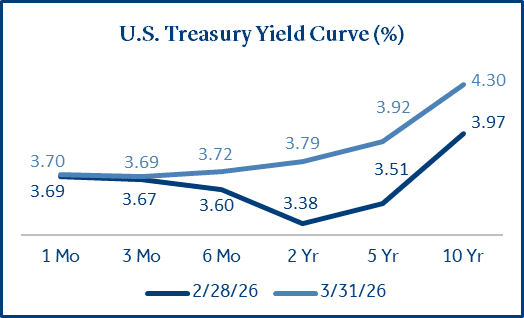
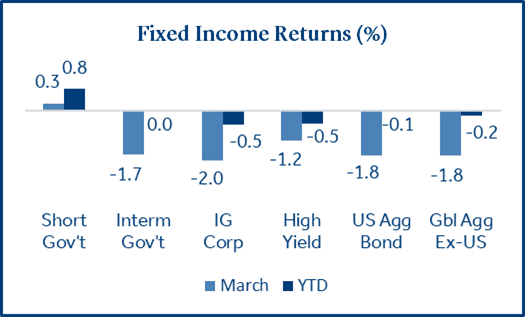
The Bloomberg US Agg Bond Index fell -1.8% as the 10-year Treasury yield rose from 3.97% to 4.30%. Treasuries and mortgage-backed securities lost -1.7% while investment grade corporate bonds declined -2.0%.
International equities lagged on rising oil prices and a strong U.S. dollar:
Developed and emerging markets fell -10.3% and -13.1%, respectively. Europe and Asia are both energy importers (net) which makes them especially vulnerable to rising energy prices. Additionally, i
Equities
U.S. equities recorded their largest monthly decline since March 2025.
Stocks traded with heightened volatility in March as investors balanced an uncertain economic backdrop of higher oil prices and rising interest rates against resilient corporate earnings growth.
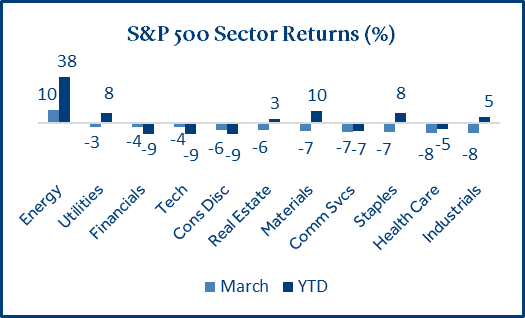
The energy sector was a bright spot due to rising oil prices:
Driven by an oil supply shock in the Middle East and rising demand for power to support AI infrastructure, energy stocks have soared and decoupled from the broader market. Domestic oil producers like Exxon and Chevron rallied sharply as their assets are seen as being insulated from the turmoil in the Middle East.
Asset heavy sectors posted strong returns during the first quarter:
A key trend in early 2026 is the investor rotation into Materials, Energy, Staples and Industrial “MESI” stocks that produce physical goods which could make them less vulnerable to AI-related disruption.
Investors favored higher yielding sectors as they adopted a more defensive posture:
The yield factor (+5.7%) has proved more resilient than the broader market year-to-date. Dividend paying, value-oriented sectors such as energy, utilities, staples, and materials benefited from strong cash flows, pricing power, and exposure to higher commodity prices. Reflecting this shift, value stocks (+2.1%) significantly outperformed growth stocks (-9.8%) in the first quarter.
Fixed Income
Bond returns were mostly negative as interest rates jumped and Fed rate cut expectations faded.
Treasury yields rose across maturities as inflation pressure, higher energy prices, and resilient U.S. economic data reduced expectations for near term Fed rate cuts.
Longer-term yields rose on signs of sticky inflation:
Consumer inflation (CPI) rose 2.4% (annualized), unchanged from January. More concerning for investors was the producer price index (PPI), which measures the change in selling prices for U.S. producers. PPI rose 3.4% year over year, above January (+2.9%) and materially higher than expected (+3.0%).
Interest rate futures indicate the Fed is likely to leave rates unchanged in 2026:
Investor expectations for higher rates, due to stubborn inflation and rising energy costs, weighed on bond returns. There is now a 74% probability that the Fed will not cut rates this year. At the beginning of the year, investors had expected two -0.25% rate cuts in 20261
Private Credit
Private credit has been in the spotlight as first quarter investor redemption requests were elevated.
Private credit is a type of debt financing where non-bank lenders provide loans directly to companies. The loans are negotiated privately and often carry higher yields to compensate investors for reduced liquidity. Private credit funds are often structured as semi-liquid interval funds, which limit redemptions to a certain percentage of assets on a periodic basis (e.g., 5% of NAV per quarter).
Withdrawal limits are designed to protect investors:
Recent headlines have highlighted instances where redemption requests have exceeded a fund’s stated quarterly limit (e.g., 5% of NAV). Private credit portfolios consist of loans intended to be held over a long-term time horizon. When redemption requests exceed quarterly limits, the fund advisor determines whether excess redemptions will be satisfied or if the redemption requests will be paid on a pro-rata basis.
Publicly traded BDCs were under pressure as risk appetite declined:
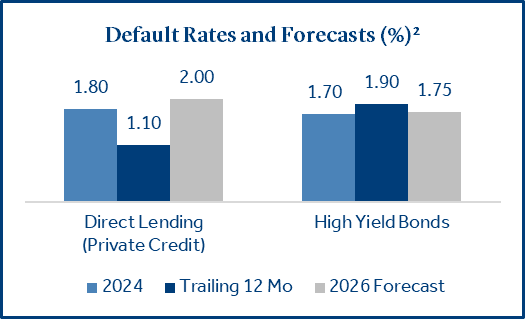
BDCs are closed-end funds that hold non-investment grade loans and offer daily liquidity through shares that can trade at a premium or discount to the NAV (recorded loan values). During Q1, the S&P BDC Index declined ‑10.1%, reflecting increased selling pressures facing the asset class. The selling pressure reflected weaker investor sentiment more so than a change in the underlying credit fundamentals as default expectations have remained relatively stable2
Geopolitical Events
Tensions in the Middle East have escalated, which has triggered volatility within capital markets.
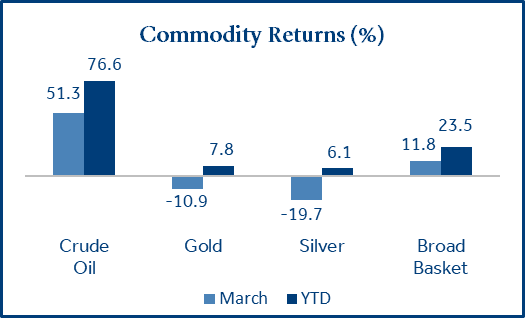
From an economic perspective, the most significant impact of the Middle Eastern conflict has been the rise in energy prices and the resulting risk of renewed inflationary pressure. Iran’s restrictions on the Strait of Hormuz, which is a major transit route for roughly 20% of the global oil supply, has been a key driver of higher energy prices.
Rising oil prices reflect geopolitical supply risk rather than demand-driven growth:
Higher energy prices could benefit energy producers and commodity-linked assets in the near-term, but they increase the risk of rising inflation, potentially complicating central bank policy and weighing on consumer spending.
Gold and silver prices fell as rates rose:
Rising rates increase the opportunity cost when holding non-yielding assets like gold and silver. Further, the U.S. dollar appreciated in March (+2.4%) which can create headwinds for gold and silver in dollar terms.
Asian economies could be the hardest hit by higher oil prices:
Japan, South Korea, and China import a majority of their oil from the Middle East. Energy accounts for a larger portion of household and corporate spending in these economies, resulting in higher prices for transportation, food, and manufacturing.
Economic Calendar
Recent economic data provided mixed signals as inflation concerns persisted.
U.S. nonfarm payrolls unexpectedly declined by -92k in February, reversing a +126k gain in January. The weaker reading raised questions about the durability of labor market momentum. At the same time, the Fed’s preferred inflation measure (PCE) remained elevated (+2.8%) and well above their 2.0% target, highlighting the ongoing challenge of balancing slower growth against persistent price pressures.
The Fed raised its GDP growth outlook but increased its inflation forecast:
Policymakers pointed to stronger than expected business investment, AI-related productivity gains, and resilient consumer spending as key drivers behind the higher growth projections. However, progress on inflation has been uneven, with officials highlighting upside risks from tariffs and rising energy prices.
Fed Summary of Economic Projections (%) - March 20263
Economic Variable | 2026 | 2027 | 2028 |
|---|---|---|---|
U.S. GDP Growth | 2.4 | 2.3 | 2.1 |
December estimate | 2.3 | 2.0 | 1.9 |
Inflation (PCE) | 2.7 | 2.2 | 2.0 |
December estimate | 2.4 | 2.1 | 2.0 |
The partial government shutdown could add to near-term uncertainty for the economy:
While the direct economic impact is typically modest if short‑lived, a prolonged shutdown could weigh on growth through delayed federal spending, reduced consumer confidence, and disruptions to government data releases that inform business and policy decisions.
Date | April Economic Data Calendar4 |
|---|---|
4/3 | Nonfarm Payrolls and Unemployment Rate |
4/9 | PCE Inflation/Final Q4 GDP Growth Rate |
4/10 | CPI Inflation |
4/21 | Retail Sales |
4/29 | Fed Interest Rate Decision |
To download the printable version, click here for the April 2025 monthly market commentary (PDF).